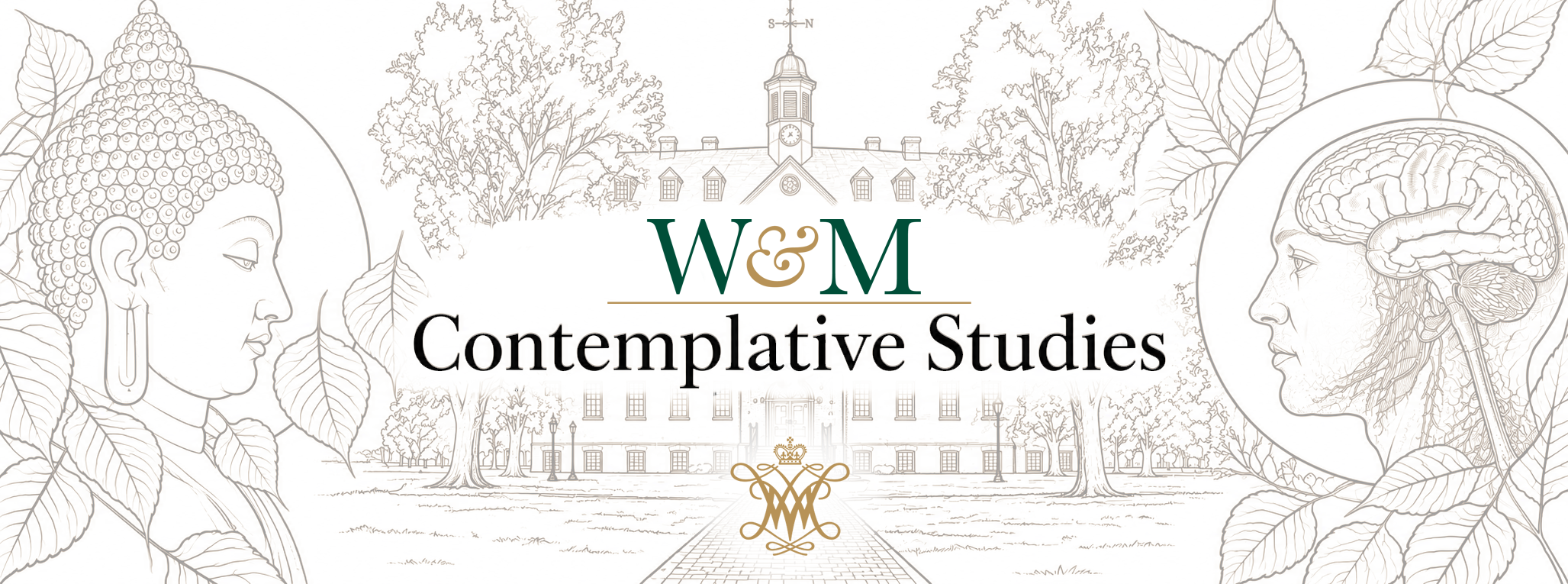
Contemplative Studies is an interdisciplinary field that draws on neuroscience, psychology, and cognitive science, alongside religious studies, philosophy, education, and the arts, to investigate contemplative practices and traditions, from meditation and mindfulness to prayer, breathwork, and movement.
By integrating scientific research with humanistic inquiry, the field explores how these practices influence well-being, cognition, self-understanding, ethics, and engagement with others and the world.
‘Big Questions’ Pursued in Contemplative Studies
What exactly is consciousness, and can first‑person experience count as scientific evidence?
How do contemplative practices reshape attention, emotion, and decision‑making in everyday life?
What is the relationship between mind, body, and brain—and how does paying close attention alter it?
Can compassion, empathy, and wisdom be intentionally trained—and how would we measure that?
What does contemplative practice reveal about what it means to live a good, flourishing life?
How might practices like meditation or mindful awareness support social change and collective well‑being?
Areas of Research within Contemplative Studies
Clinical Applications in Mental Health
•Mindfulness-Based Cognitive Therapy (MBCT) and Mindfulness-Based Stress Reduction (MBSR) are evidence-based interventions for depression, PTSD, and chronic pain.
•Contemplative practices are increasingly being integrated into mainstream clinical psychology and psychiatry, creating career pathways for students.
Neuroplasticity and Meditation
•Studies using fMRI and EEG show that mindfulness and compassion meditation can alter brain structure and function—thickening the prefrontal cortex, enhancing connectivity in attention networks, and reducing amygdala reactivity.
•Research shows how contemplative practices can literally reshape the brain, offering non-pharmacological interventions for stress, anxiety, and depression.
Cross-Cultural and Philosophical Dimensions
•Comparative studies of Buddhist mindfulness, Hindu yoga, and Christian contemplative prayer explore how cultural frameworks shape cognitive and affective processes.
•This offers a global, interdisciplinary perspective—valuable for students interested in cultural neuroscience or the psychology of religion.
Contemplative Practices and Cognitive Performance
•Experiments reveal that short-term mindfulness training improves working memory, attentional control, and reduces mind-wandering—critical for academic and professional performance.
•This research links ancient practices to measurable improvements in executive function, making it relevant for psychology and neuroscience students interested in applied cognitive science.
Psychophysiology and Stress Regulation
•Studies on heart-rate variability, cortisol levels, & immune function demonstrate that contemplative practices enhance resilience & reduce physiological markers of stress.
•This work bridges neuroscience and health psychology with practical interventions for well-being.
We use cookies to ensure that we give you the best experience on our website. If you continue to use this site we will assume that you are happy with it.